March, 1991                                                                                  PDF Version

Fusarium Wilt Resistance
Fusarium oxysporum Schlecht f. sp. medicaginis (Weimer) Snyd. & Hans. S. Nygaard and D. K. Barnes

PLANT CULTURE

Greenhouse

Container..........

Bench, pot, or flat deep enough to allow root development
Media............... Sand or soil mixture
Temp/Light........ 24 to 30°C; 16+ hour daylength
No. of Plants .... 35 to 50 per replication
No. of Reps....... 3 replications minimum
Other................ Inoculate with Rhizobium meliloti Dang, encourage vigorous growth

INOCULUM CULTURE

Source..............

Infected root tissue; axenic culture
Storage............. Inoculated sterile soil cultures or solid PDA medium
Temperature.......   0°C to ambient
Storage Life.......  Several years in soil tubes

INOCULATION PROCEDURE

Age of Plant...... 8 to 10 weeks old
Type of Inoc....... Microconidia in suspension
Inoc. Culture ..... Potato or nutrient broth (2 g NaNO3, 1 g KH2PO4, 0.5 g MgSO4-7H2O, 0.5 g KCI, 0.01 g FeSO4-7H2O, 0.5 g yeast extract, and 15 g sucrose per 1 L distilled water); inoculate sterile broth wlth PDA plugs and incubate on a shaker for 4 days at about 21°C
Concentration ... 1.6 X 10⁶ spores per mL or a 1:20 dilution of the shake culture
Method ............. Bare root soak
Time of Inoc....... 20 to 30 min.

INCUBATION

Location ........... Transplant to field
Plant Counts .... Approximately 2 wks after transplanting, count all (alive and dead) plants as the base count for initial stand
Culture ............. Maintain vigorous growth, control insects, clip plants once or twice.
Spacing ........... 0.15 m between plants, 1.0 m between rows.
Age at Rating.... 3 months after transplanting

RATING

Plants are removed from the field and the tap root sectioned for rating.

0 Resistant ............. No discoloration in the root
1 Resistant ............. Small dark strands in the stele
2 Susceptible .......... Small dark-brown arcs or rings in cross section of the stele
3 Susceptible ..........  Larger dark-brown areas, arcs or rings, or partial dark- brown ring in the outer stele
4 Susceptible .......... Entire outer stele dark brown, plant alive
5 Susceptible .......... Dead plant (stand loss)

CHECK CULTIVARS

  Approximate Expected Resistance (%) Acceptable Range of Reaction (%)
Resistant    
Agate** 54 45-65
Moapa 69 76 65-85
Moderately Resistant    
Narragansett 22 15-30
Susceptible    
MNGN-l ** 4 0-8

Values for resistant standards are totals of O's and l's.

DISTRIBUTION AND SEVERITY OF
FUSARIUM WILT
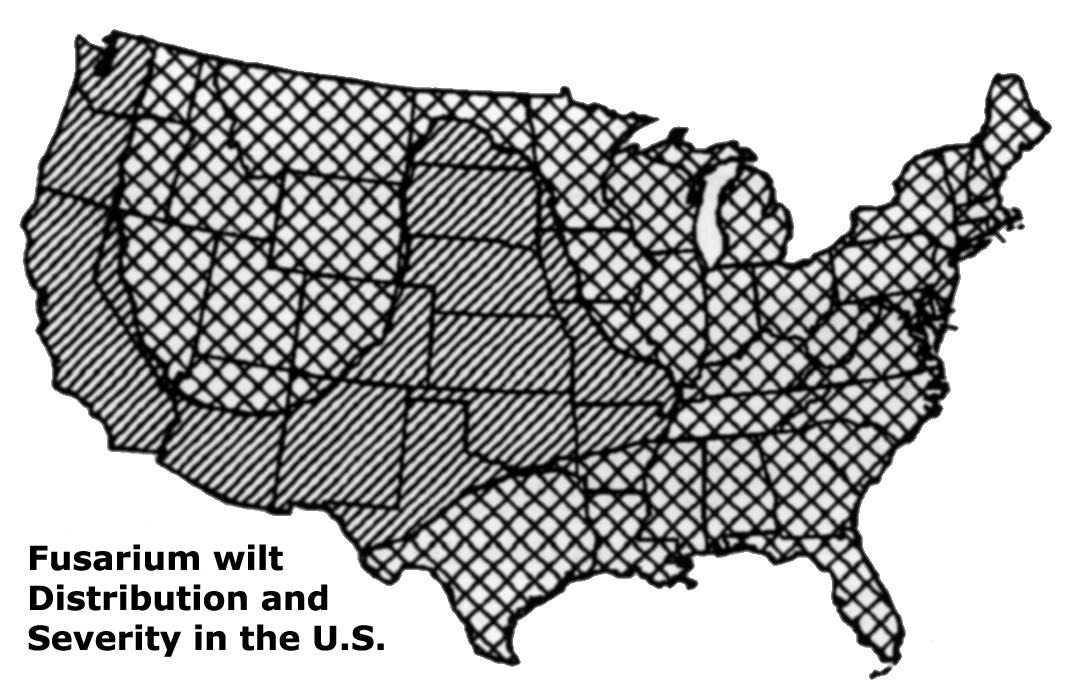
Fusarium wilt, Fusarium oxysporum Schlecht f. sp. medicaginis (Snyd. & Hans.)
(Click on the map above for a larger version. See also the KEY)

SOURCE OF INOCULUM AND EXPERTISE

Name ..............Judy A. Thies
Address ...........USDA-ARS
                        Department of Plant Pathology
                        495 Borlaug Hall
                        1991 Buford Circle
                        University of Minnesota
                        St. Paul, MN 55108
Phone ..............(612) 625-8240

CULTURE OPTIONS AND RANGE OF CONDITIONS

Mixtures of Fusarium oxysporum and Clavibacter michiganense subsp. insidiosum inocula will not influence the severity of Fusarium wilt symptoms, but it will often produce reduced symptoms of bacterial wilt (1).

PLANT GROWTH OPTIONS AND RANGE OF CONDITIONS

The same procedure can be used in the greenhouse with acceptable accuracy. Plants are inoculated and then trans planted into pots, benchs, or celled flats. Greenhouse evaluations can be rated 6 to 8 wks after transplanting.

INOCULATION OPTIONS AND RANGE OF CONDITIONS

Eight to 10 week-old plants are lifted from the soil, washed in tap water, and about 50 plants for each plot are tied in a bundle. The roots are kept in tap water until all plants for all plots in a replicate are prepared. The bundled plants are immersed in the inoculum, tops trimmed to ca. 4 cm from the crown and the roots are trimmed to ca. 12 cm length. Roots are kept in moist paper towel until transplanting.

HELPFUL INFORMATION

If not planted immediately, inoculated plants may be stored at 3 to 4°C for up to a week. A tobacco planter or modified vegetable planter works well for transplanting. It can be expected that many of the highly susceptible plants will die within 5 to 6 weeks after inoculation and transplanting. Plants are undercut at 15 cm and roots are sectioned for rating. A carrot or beet lifter or sod undercutter works wcll for this purpose. Ratings may be expressed as an ASI or as a percentage adjusted to the long-time average of the standard check cultivar. Seed of the susceptible check (MNGN-1) can be obtained from the USDA-ARS project at the University of Minnesota.

The primary method used for evaluating resistance to Fusarium wilt has been a root soak method of inoculation followed by transplanting to the field and the scoring of root symptoms about 3 months later (1,2,3).

REFERENCES

1. Frosheiser, F. l., and D. K. Barnes. 1978. Field reaction of artificially inoculated alfalfa populations to the Fusarium and bacterial wilt pathogens alone and in combination. Phytopathology 68:943-946.

2. Frosheiser, F. I., and D. K. Barnes. 1984.In Standard tests to characterize pest resistance in alfalfa cultivars. USDA Misc. Publ. No. 1434.

3. Hijano, E. H., D. K. Barnes, and F. I. Frosheiser. 1983. Inhcritance of resistance to Fusarium wilt in alfalfa. Crop Sci. 23:31-34.

Previous Page